This season, the chain perimeter of the Armour Center fountain lights up with programmable LED lights, and anyone at the fountain can pick the show from their phone. Materials are the only cost — design, fabrication, and installation are donated.
Loading design…
Not sure which fountain? Here it is on Google Street View: drag to look around (a daytime photo from before the lights).
The Fountain Jukebox — anyone at the fountain can pick the lights
A small sign stands at each of the fountain's three open sidewalk entries. Anyone passing by can scan the code and, in a few taps on their own phone, change the fountain's lights — no app to install, nothing to sign up for. Like a jukebox, but the songs are light shows: a small piece of interactive public art the whole neighborhood shares.
- Scan the code on the sign with your phone's camera.
- Browse the on-screen library of light shows and pick one.
- Watch the fountain change within a few seconds — for everyone there.
- Line up your favorites: see what's already been picked and queue the next shows in turn, so everyone gets a moment.
Picks come from a curated library of seasonal, ambient, and motion shows, each with its own colors and pace to customize; between picks the fountain runs its own gentle display. Some shows come with sound — a song, or the clack of a Newton's cradle — played on your own phone in time with the lights, if you choose to turn it on; the fountain itself stays quiet. From anywhere else, the site shows the fountain live — watch, and preview any show — and picking opens once you've scanned the sign at the fountain.
- LED run (chain)
- Park outlet & 12 V supplies · one per quadrant, center-fed
- 120 V feed · from the one existing outlet
- Control quadrant · Pi · F16v5 · radio
- Cat5e run · SRx receiver
Power
The site has one outdoor outlet, on the south-east side of the ring, and everything runs from it. A GFCI-protected 120 V feed follows the fence line around the perimeter to a small weatherproof box at the center of each quadrant, where that quadrant's 12 V supply sits. Each supply feeds outward in both directions, so the farthest pixel is only about half a quadrant away — brightness and color stay even end-to-end, with no separate power injection required. The whole display draws about 3.5 amps at its brightest and closer to two in normal use, well inside a single household circuit. The long perimeter distances are crossed only by data (Cat 5e) and mains power — never low-voltage DC — and where a cable crosses a sidewalk it runs beneath a cable ramp.
Communications & reliability
A small controller (Raspberry Pi) at one quadrant drives the show and links back to the residence over a point-to-point wireless bridge. Pixel data reaches the other three quadrants over Cat5e using isolated long-range differential receivers — robust over the full perimeter with no signal boosters and per-quadrant fault isolation. The receivers report each run's current and fuse status back to the controller, and every few minutes those readings — with the controller's own supply and temperature and the wireless link's signal — come home, so a problem shows up before anyone has to walk out to look. The pixels themselves use a redundant (dual) data line: if a single pixel ever fails, data routes around it so only that one dot goes dark rather than the rest of its run. And because each quadrant is electrically isolated, no fault can reach beyond its own quarter of the ring.
Fabrication & installation
Donated in full — design, assembly, installation, and seasonal removal. The figures below cover materials only.
Bill of materials (approximate)
| Item | Qty | Unit | ~Unit | ~Total |
|---|---|---|---|---|
| Total materials (est.) | ||||
Timeline (2026 season)
- Sept 18 ✓ Presented to the HOA board, which gave it its full support.
- September ✓ Measured on site. Every chain span measured, so nothing is guessed in the field: 25 lights on every span, 1,000 in all.
-
Sept 25 ✓
Working on the bench. Controller, pixel controller, and a
test string running end to end — a pick on a phone lights real pixels.
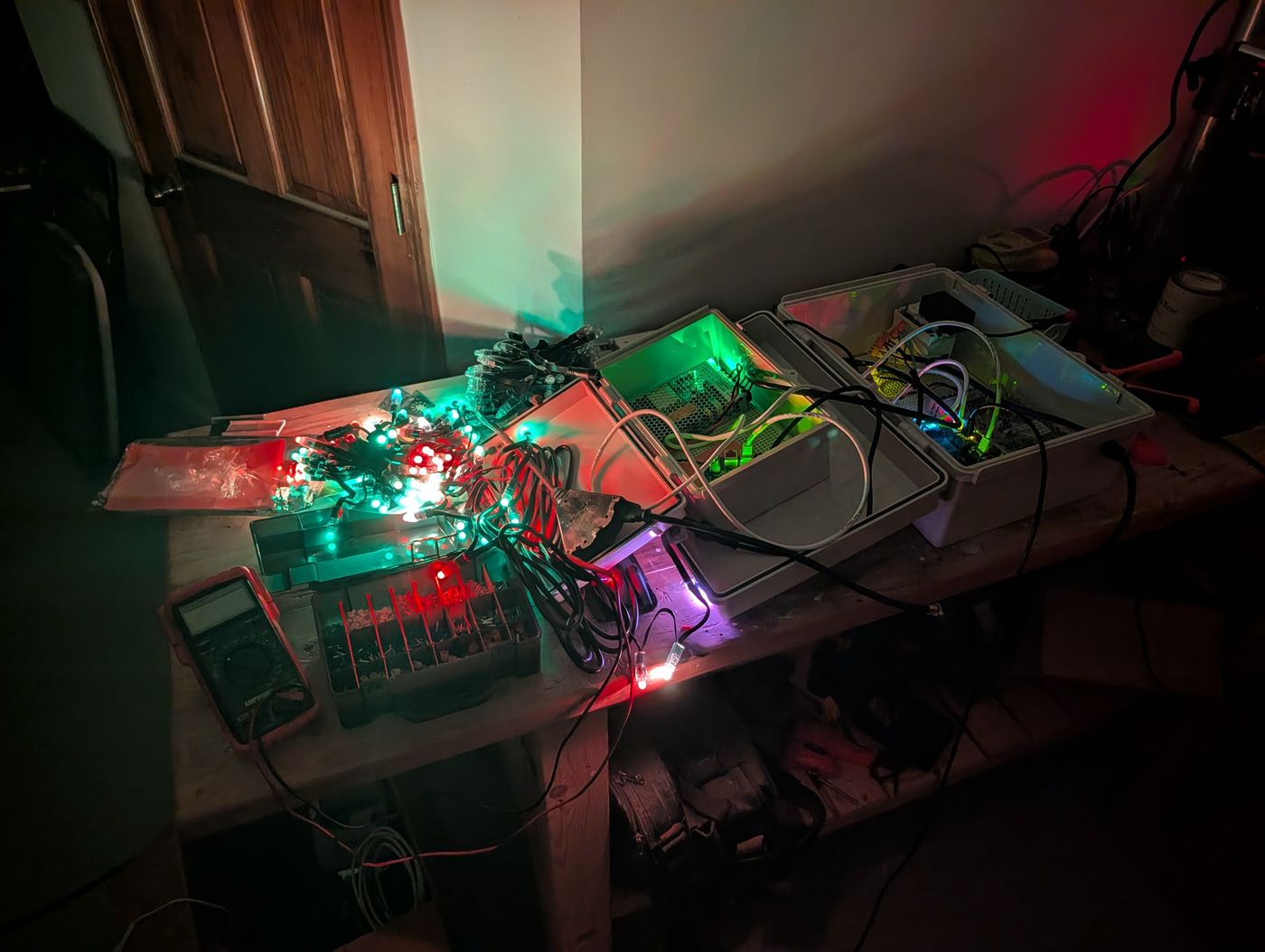
First light on the bench, Sept 25. - Sept 30 ✓ Signs ordered — one for each open entry.
- Early October ✓ Shop build. Pixels, wiring, and the four weatherproof enclosures pre-assembled indoors, and every run of lights tested on the bench — most of the work done warm and off-site.
- Oct 10 ✓ Signs up at each open entry.
- Oct 18 ✓ Installed and lit. Mounted on the chain, signal run between the quadrants, powered up and tested — the lights came on that evening.
-
Now, through the season
Live every night, on a schedule that looks its best while
respecting the neighborhood:
- Lights on
- Just before dusk (already glowing as the sky darkens)
- Interactive
- From lights-on until 10:00 p.m. — anyone at the fountain can pick shows from their phone
- Ambient
- 10:00 – 11:00 p.m. — its own gentle display, controls paused
- Lights off
- 11:00 p.m.
- January Seasonal removal. Everything comes down in labeled sections and is stored ready to re-hang — so each following year is a quick re-install, not a rebuild. Nothing is left at the fountain in the off-season.
Who made this
I'm Jacob Hoover, a neighbor a short walk from the fountain. I designed and built the Fountain Lights — the lights and electronics, the software that runs them, this site, and the install — and neighbors have chipped in toward the materials.
Want something like this for your street, school, business, or event? I'd love to hear about it — send a note or find my number and email on the support page.